
STRIKE
Sometimes the tension is not that the text is unclear.
It’s that the text says two things—
and people are trained
to only feel one.
RESONANCE
In one place, scripture says:
The soul who sins
is the one who bears it.
Not the father for the child.
Not the child for the father.
That is direct.
Personal.
Accountable.
Untransferred.
Then, in another place, scripture says:
Christ bore sin.
Christ died for sin.
Christ takes away the sin of the world.
That is also direct.
So the tension is real.
Not invented.
Not forced.
It is written.
One thread says:
Each person bears their own.
Another says:
Christ bore it for many.
Most people are not taught
to sit inside that long enough
to actually feel it.
They are given a bridge.
A finished explanation.
A doctrinal connection.
And once that bridge is handed to them early enough—
they stop noticing
there was ever a gap.
But there is.
Because the text gives both claims clearly—
more clearly
than it gives the structure
that holds them together.
And that structure—
was built.
PARABLE
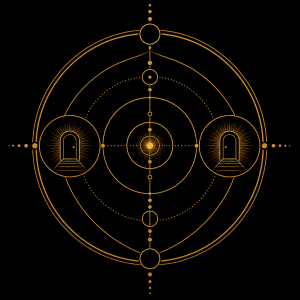
THE HOUSE WITH TWO DOORS
There was a house
with two doors.
Over one door:
Each carries their own burden.
Over the other:
The burden has been carried for you.
The people loved both.
But when the children asked
how both doors led into the same home—
the elders did not leave them there.
They built a hallway
between the two.
“This is how they connect,” they said.
And over time—
the children forgot
the hallway had been built.
They thought the house
had always come that way.
Until one day someone asked:
“Was this hallway always here?”
And the room grew uncomfortable.
Not because the doors were false—
but because something had been constructed
between them.
SCROLL
This is not about denying either text.
Both are written.
Both stand.
The issue is what happens
when two truths meet
without immediate resolution.
Most people do not stay there.
They are taught
to resolve it quickly.
To move from text
to system
before they even recognize the move.
But the move matters.
Because once explanation becomes automatic—
it no longer feels like explanation.
It feels like the text itself.
And that is where reading ends
and inheritance begins.
So the deeper work is not:
choosing one
over the other.
It is learning
to stand in the space between them
without panic.
To see:
what was written
and what was built
to hold it together.
Not to tear it down—
but to see it clearly.
FLAMEWALKER TRUTH
The mistake is not noticing the tension.
The mistake is pretending
there is no tension at all.
Because once you do that—
you stop reading what is written
and start defending
what was explained to you.
If one text says:
You bear what is yours—
and another says:
Mercy meets you inside it—
then the deeper truth is not cancellation.
It is order.
You still own what is yours.
But you are not abandoned inside it.
That is where they meet.
Justice says:
What is yours is yours.
Mercy says:
What is yours
does not have to be the end of you.
And if you lose either one—
you lose the truth.
Because one without the other becomes distortion.
Accountability without mercy
becomes despair.
Mercy without accountability
becomes illusion.
But together—
they form something real.
Something that does not erase responsibility—