STRIKE
We didn’t change the story.
We stopped reading
the altered version.
RESONANCE
There’s a phrase that sounds simple—
until you sit with it:
“Alter and change mean the same thing…
but if you alter your pants,
you’re going to have to change your pants.”
At first, it feels like wordplay.
But underneath it—
is a distinction
most people miss.
Because not all “change”
is the same kind of change.
When you alter something—
you modify the thing itself.
You cut it.
Shape it.
Adjust it to fit expectation.
And once you do—
it is no longer
what it was.
It becomes something new.
But when you return—
you don’t change the thing.
You change how you see it.
And that’s where the confusion lives.
Because what feels like change—
is often just the removal
of what had already been changed.
Over time—
the story wasn’t rewritten.
It was layered.
With images.
With assumptions.
With simplifications.
Small things.
Human things.
But enough of them—
and the layered version
began to feel original.
So when you return—
and actually read what is there—
it can feel like something is shifting.
Like something is being adjusted.
Like the story is being changed.
But nothing is being changed.
Something is being uncovered.
PARABLE
THE TAILOR
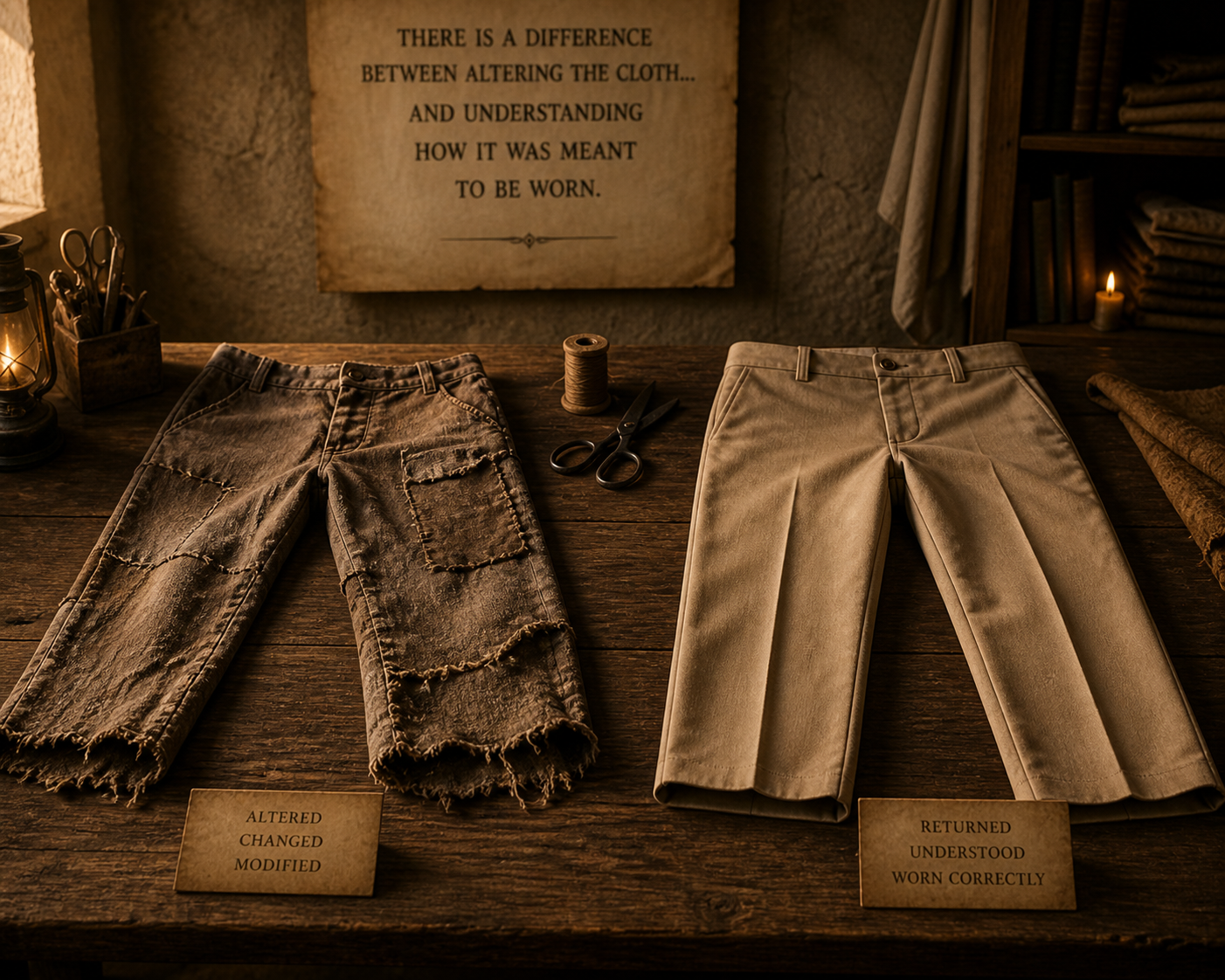
A man brought his trousers to a tailor.
“They don’t fit,” he said.
So the tailor altered them.
Cut the fabric.
Reshaped the seams.
Stitched them to preference.
When he was done—
they fit differently.
But they were no longer
what they had been.
Another man came in
with the same complaint.
“They don’t fit.”
The tailor looked at him—
then at the trousers—
and said:
“Put them on again.”
The man adjusted
how he stood.
How he wore them.
How he moved in them.
And suddenly—
they fit.
The trousers were never wrong.
The wearing of them was.
And the tailor said:
“There is a difference
between altering the cloth—
and understanding
how it was meant to be worn.”
SCROLL
The distinction between altering and returning—
is the difference
between distortion and clarity.
To alter—
is to modify the source
to match perception.
To return—
is to adjust perception
to match the source.
Nothing in the text changed.
The words remained.
The structure remained.
The account remained.
What shifted—
was the overlay.
Assumptions repeated as truth.
Images accepted as scripture.
Fragments held without context.
When those layers are removed—
the text does not weaken.
It clarifies.
But clarity can feel like disruption—
to someone who has only known
the layered version.
Because what they are losing—
is not truth.
It is familiarity.
And that is where resistance forms.
Not against the text—
but against the removal
of what was never part of it.
So the work is not to change the story.
It is to stop carrying
what was added to it.
FLAMEWALKER TRUTH
Truth does not need to be altered
to become understandable.
It needs to be returned to.
Because every time we alter—
we move further from origin.
And every time we return—
we move closer
without changing a single line.
So do not confuse clarity
with change.
And do not mistake discomfort
for distortion.
Sometimes what feels like
something being taken—
is actually something
being given back.
And the difference—
is everything