STRIKE
We hear “three days”
and we count with a modern clock.
Seventy-two hours.
Exact.
Measured.
Clean.
But the text was never written
inside our stopwatch.
RESONANCE
This is one of those places
where people think the problem is in scripture—
when the problem is in the lens.
Friday to Sunday
does not satisfy modern precision.
So people start adjusting the story.
They shift the crucifixion.
Stretch the hours.
Rebuild the timeline
to make it fit
what we mean by three days.
But the ancient world
did not count the way we do.
Part of a day
could stand for a day.
That changes everything.
Because now the tension
is not in the text.
It is in our assumption
that ancient language
must submit
to modern math.
And once again—
we are not dealing with something false.
We are dealing with something
heard through the wrong system.
PARABLE
A traveler once entered a town
where time was marked differently.
He asked how long a journey would take.
The villagers said,
“Three days.”
So he prepared himself
for three full turns of the sun—
hour by hour,
expecting exactness.
But when the journey ended sooner than that,
he accused them.
“You said three days.”
And they answered,
“Yes.”
He argued with them
using the clock in his hand.
They answered him
using the language in their mouths.
Only then did he understand:
The conflict had never been in the journey.
It was in the counting.
He had mistaken his system
for the only system.
And because of that,
he thought the road was wrong—
when it was only his expectation
that had misled him.
SCROLL
The resurrection timeline is often treated
as a mathematical problem
because modern readers hear “three days”
as three complete twenty-four-hour periods.
But that is not how ancient Jewish timekeeping
necessarily worked in speech.
In that context,
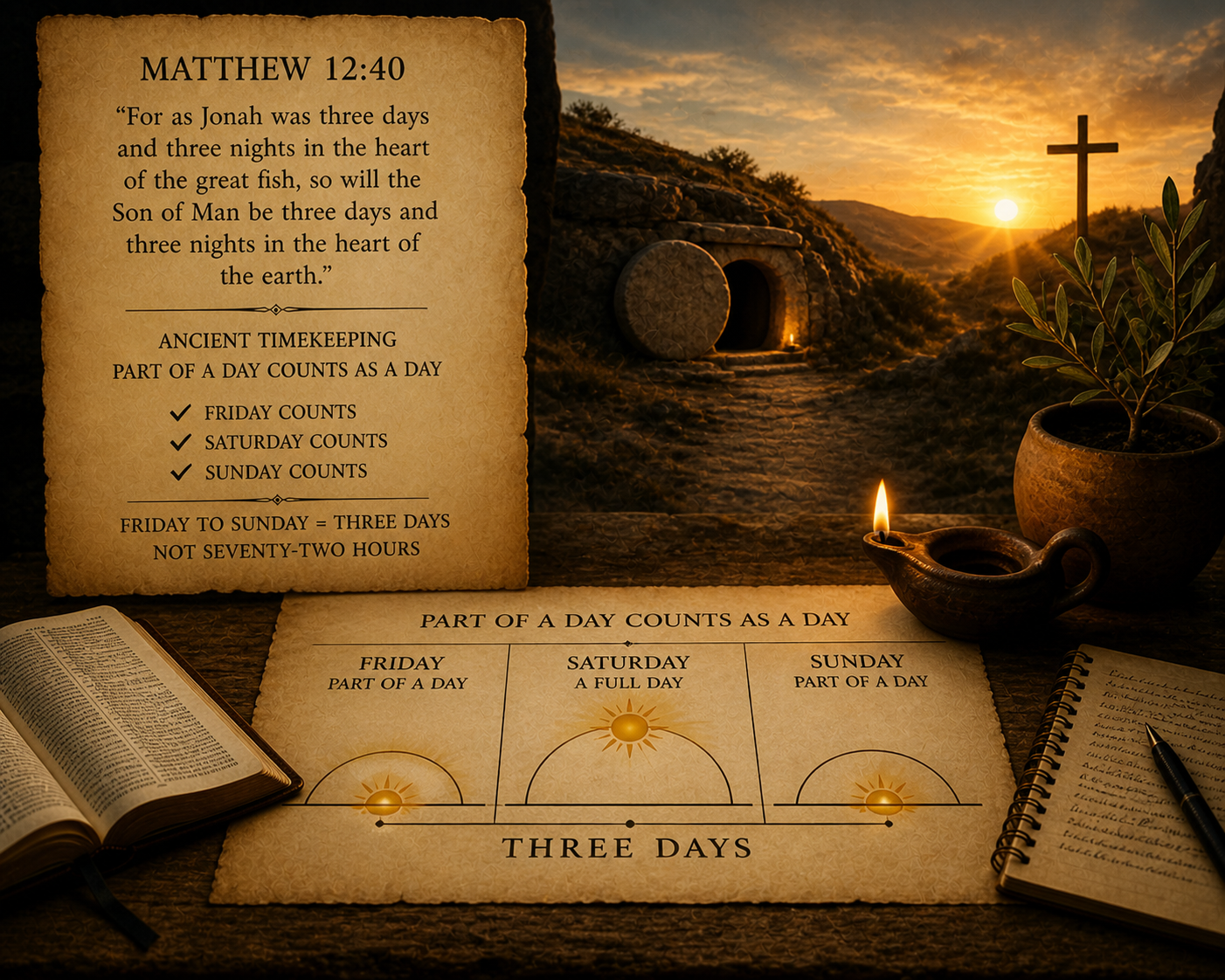
any part of a day
could count as a day.
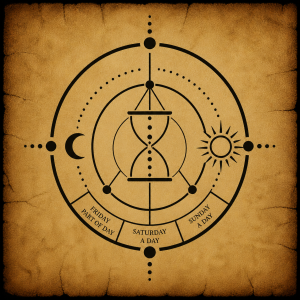
So Friday counts.
Saturday counts.
Sunday counts.
This does not require the text to be manipulated.
It requires the reader
to understand the idiom.
Matthew 12:40 is often pulled into tension
with the Friday-to-Sunday framework
because “three days and three nights”
sounds exact to modern ears.
But ancient language
did not always function
with modern mechanical precision.
The problem, then,
is not that scripture failed its timeline.
It is that later readers
tried to force ancient speech
into a modern measurement system—
and then called the mismatch
a contradiction.
This is another pattern of distortion:
Not addition.
Not subtraction.
But translation of worldview.
We hear old words
through new habits—
and assume the old words are broken
when they refuse to sound like us.
FLAMEWALKER TRUTH
Sometimes the misunderstanding
is not in what was said.
It is in how we count.
We keep trying to make the ancient world
submit to our precision,
our categories,
our habits of measurement.
But truth does not become clearer
because we force it into our frame.
Sometimes clarity comes
when we loosen our grip
and let the text speak
in the rhythm it was written in.
Not every tension
is a contradiction.
Sometimes it is a reminder
that we are not the center
of the language we inherited.
And if we want to understand the page—
we must stop demanding
that it think like we do