STRIKE
We remember it as a solitary road.
One man.
One cross.
One uninterrupted burden from beginning to end.
That’s the image we were given.
But the text doesn’t protect that image.
Because somewhere along that road—
the weight changed hands.
RESONANCE
We prefer the version where he carries it alone.
It feels stronger.
Cleaner.
More complete.
But the written account
doesn’t hold that line.
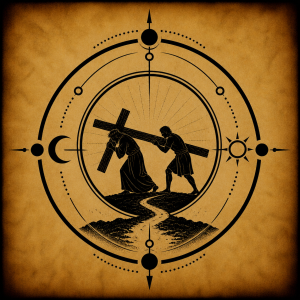
In John 19:17,
he goes out bearing the cross.
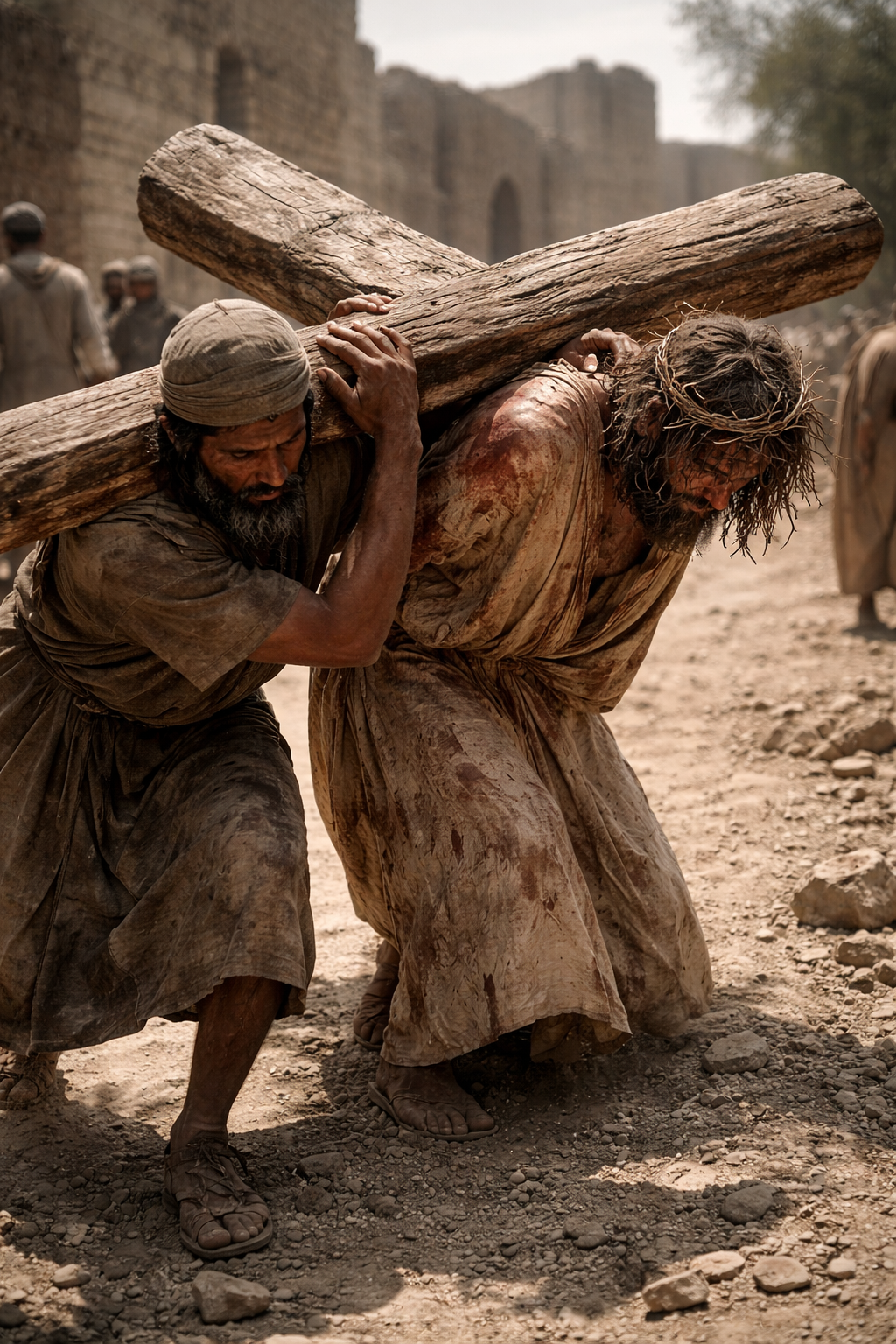
But in Matthew 27:32,
they compel another man—
Simon of Cyrene—
to carry it.
Not by choice.
Not by calling.
Just pulled into the moment.
And just like that—
the story shifts.
Not from truth—
but from the version we were taught to see.
Because we were handed an image of isolation,
when the text quietly shows interruption.
We were handed a picture of singular suffering,
when the text reveals a shared weight.
PARABLE
A man once watched a procession
pass through a narrow road.
At the front—
a figure bent under wood,
step after step,
dragging weight through dust and heat.
The crowd whispered:
“He carries it alone.”
And the man believed them.
Because that’s what it looked like.
Because that’s what everyone said.
But as the road curved,
and the crowd shifted—
another figure stepped in.
Not chosen.
Not prepared.
Not willing.
Just there.
Hands forced onto the beam.
Shoulder pressed under strain.
Walking beside what he did not ask for.
The first man did not disappear.
The weight did not vanish.
But something changed.
And the watcher realized—
he hadn’t been seeing the whole road.
Only the part
that was easy to remember.
So he turned to the crowd and asked:
“Why didn’t anyone say it was shared?”
And they answered:
“Because the story is stronger
when it stands alone.”
The man looked back at the road—
at the dust,
the weight,
the second set of hands—
and said quietly:
“Or maybe…
we just didn’t want to see it that way.”
SCROLL
The crucifixion account is not altered in text—
but it is reshaped in memory.
We are shown a continuous image
of solitary burden,
yet the written record
reveals interruption.
A moment where another is pulled in.
A moment where the weight is not carried alone.
This matters.
Because when we simplify the story into isolation,
we miss what the text allows:
That even in the most extreme suffering,
there was a point
where the burden was shared.
Not glorified.
Not explained.
Not elevated.
Just… present.
And like so many things—
it was not removed.
It was simply not emphasized.
The danger is not that the story was rewritten.
The danger is that we remember
only what fits the version we expect.
So we repeat the image of aloneness,
while the text quietly holds a different detail
for anyone willing to return
and read it again.
FLAMEWALKER TRUTH
The distortion is not always in what was added.
Sometimes it’s in what was left out
of the telling.
We were given a version
that highlights isolation—
because isolation is easier to frame,
easier to elevate,
easier to control.
But the written word
does not hide the moment
where the weight was shared.
So the question is not:
Was the burden real?
The question is:
Why were we taught
to see it as completely alone?
Return to the text.
Because when you do—
you begin to see
what was always there—
waiting beneath the version
that was easier to carry.