STRIKE
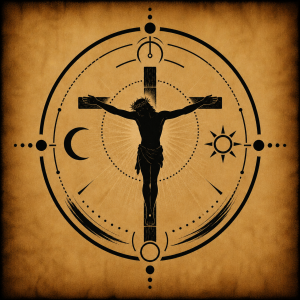
We see it clearly.
Arms stretched.
Nails placed.
Feet fixed in one exact position.
Everyone sees the same image.
But the text never gave us that picture.
RESONANCE
There is a confidence people carry about the crucifixion.
Not just that it happened—
but how it looked.
Where the nails went.
How many there were.
How the body was held.
It feels certain.
But that certainty doesn’t come from the page.
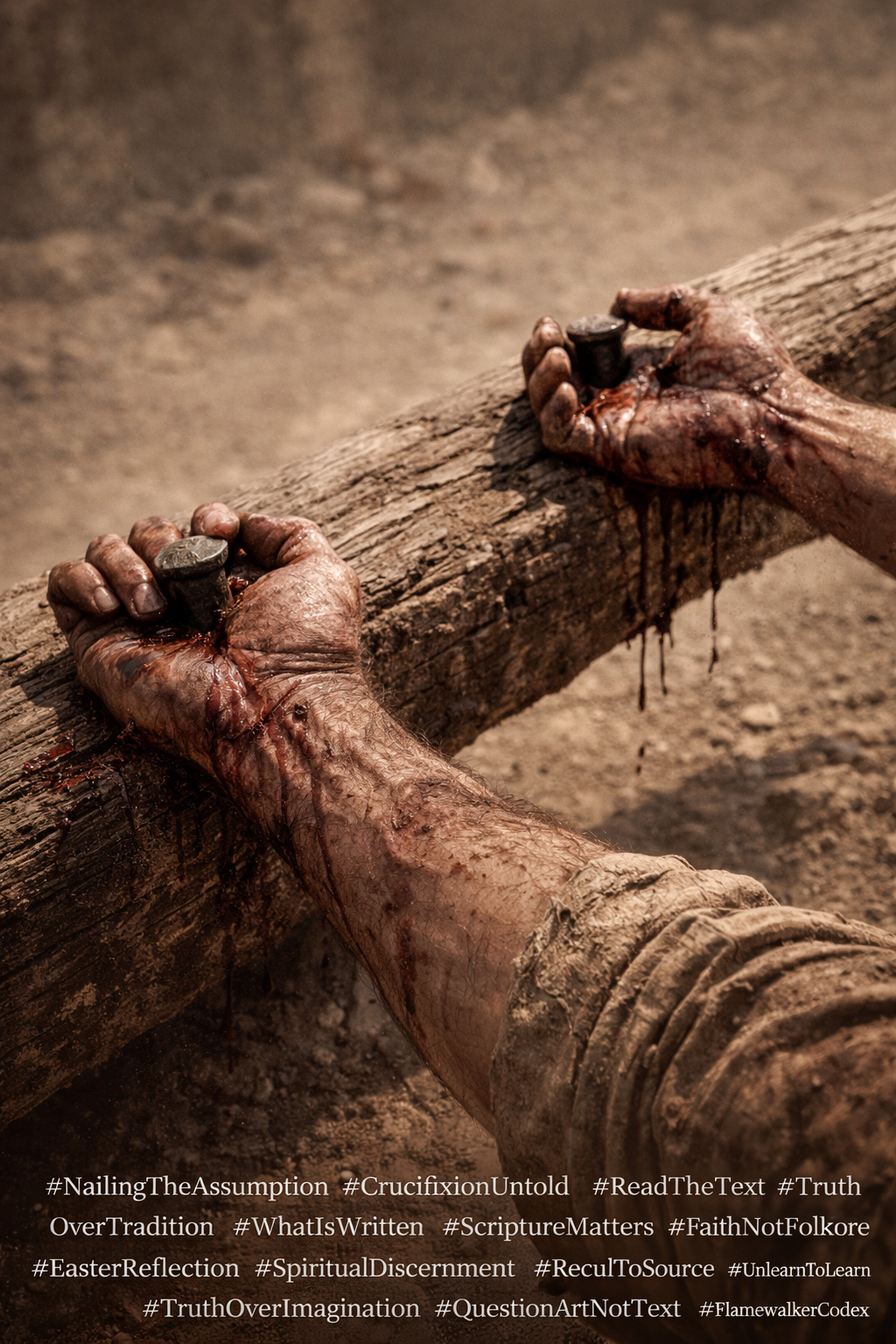
In John 20:25, the only detail given is this:
“The print of the nails…”
That’s it.
No placement.
No number.
No diagram of suffering.
And yet, over time, the silence was filled.
Artists painted it.
Teachers repeated it.
Images standardized it.
Until what was imagined
felt remembered.
PARABLE
A craftsman once entered a hall
where a great story was carved into the walls.
At the center was a figure fixed to wood—
arms stretched wide,
nails placed with perfect symmetry.
The carving was precise.
Detailed.
Unquestioned.
People gathered around it daily,
pointing to the exact placement.
“This is how it was,” they said.
“Look how clearly it’s shown.”
The craftsman stood quietly.
Then he asked,
“Who saw it happen?”
No one answered.
So he asked again,
“Who wrote that detail down?”
They hesitated.
Because when they returned to the original record,
they found something unexpected—
Not a diagram.
Not a placement.
Not a count.
Only a single trace:
Nails.
The craftsman looked back at the carving.
It wasn’t wrong because it existed.
It was wrong
because it had been accepted
as though it came from the source.
And he said:
“It’s not the image that misleads you.
It’s forgetting
where the image came from.”
SCROLL
The crucifixion is one of the most central events in the text.
And yet, some of the most visually certain elements
are among the least described.
The presence of nails is written.
The placement is not.
The number is not defined.
The posture is not mapped.
What we carry in memory
has been shaped far more by tradition and depiction
than by direct description.
This does not remove the event.
It reveals the layer placed over it.
And that layer matters.
Because once an image is repeated enough times,
it becomes indistinguishable
from the text itself.
People defend it.
Teach it.
Pass it on
as if it were written.
But the page remains quiet.
And that quiet is not emptiness.
It is space.
Space where the reader must choose
whether to stay with what is written
or accept what has been added.
FLAMEWALKER TRUTH
The distortion is not always a lie.
Sometimes it is a detail
that was never given—
but was accepted anyway.
And once accepted,
it becomes harder to question
than something openly false.
Because it feels familiar.
Because it has been seen.
But truth does not come from repetition.
It comes from returning.
So when the image feels certain—
but the text is silent—
trust the silence.
Because what was not written
was never meant to be assumed.
And what was added
should never replace
what was actually there