STRIKE
Every institution eventually reaches a moment
when the records of its past
become as important
as the story it tells about that past.
For much of the twentieth century,
access to historical archives was limited.
Documents were preserved carefully—
but interpretation remained
within official channels.
Then something shifted.
The rise of professional historical inquiry—
and voices like Leonard J. Arrington—
began opening a different approach.
Records were no longer only preserved.
They were examined.
And that shift did not end.
Digital archives.
Independent historians.
Global scholarship.
Now the question is no longer:
What happened?
The question is:
Who gets to see it?
RESONANCE
Archives are not just paper.
They are memory.
Every document stored
is a moment someone decided
was worth remembering.
But memory changes
when it becomes accessible.
Details once held quietly
in the margins—
begin to move
into public conversation.
For some,
this feels like a threat.
For others,
a deepening.
But both reactions
come from the same place:
The understanding
that history shapes identity.
PARABLE
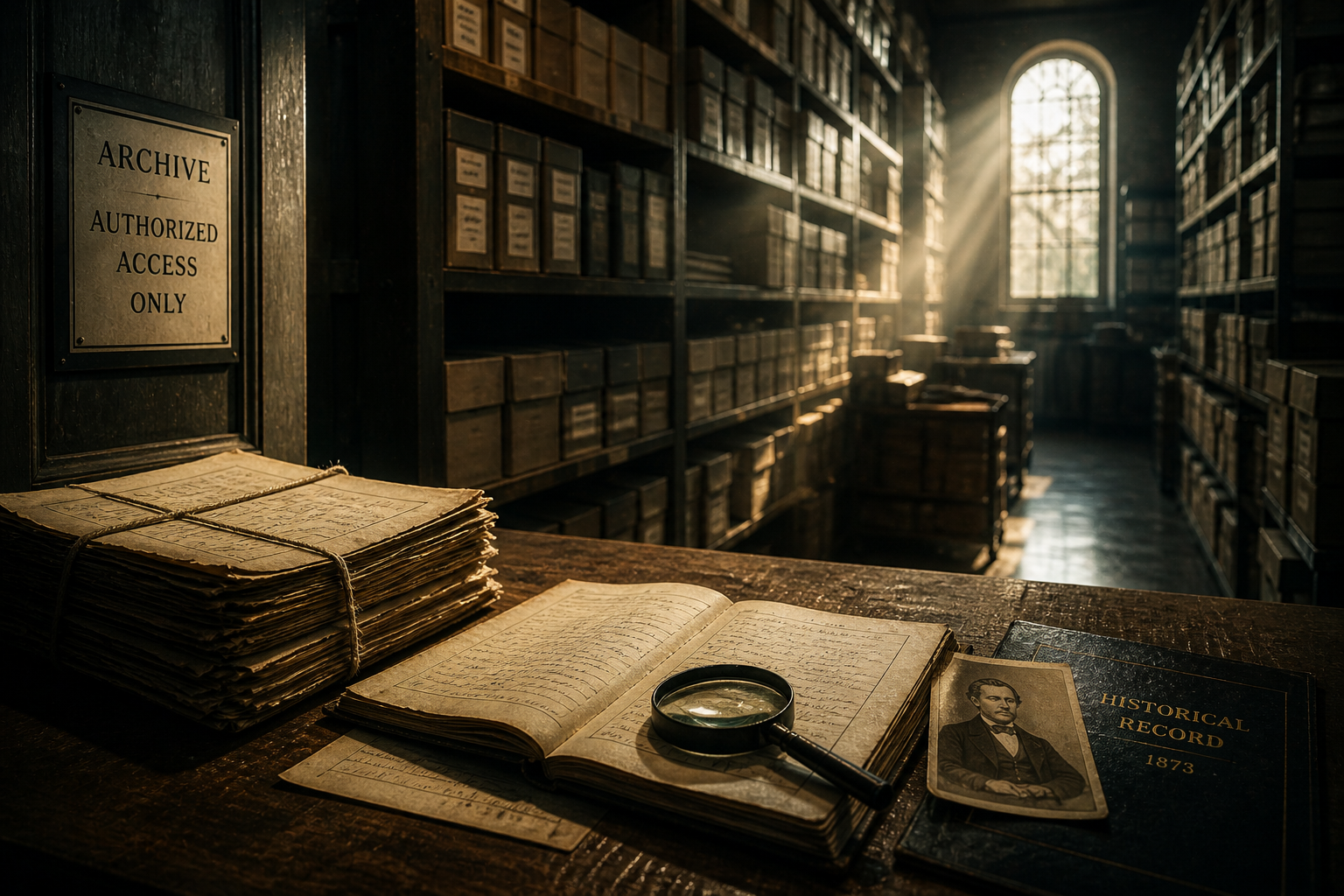
There was once a great library.
Inside its walls
sat the story of a people.
For generations,
only a small group
held the keys.
They protected the shelves.
They preserved the books.
They told the story.
Then one day—
the doors opened.
Students arrived.
Researchers arrived.
Descendants arrived.
They began reading
the same pages.
Some passages confirmed
what was always known.
Others revealed details
that had rarely been spoken.
The library did not change.
But the number of readers did.
And with more readers—
came more ways
of seeing the same shelves.
SCROLL
The coming debates
will not be driven
by hidden discoveries alone.
They will be driven
by access.
Digital technology
has changed the structure of memory.
Records once kept in quiet archives
now move across the world
in moments.
History is no longer
a guarded room.
It is becoming
a shared space.
For religious communities,
this shift carries weight.
Sacred narratives
were often held
within trusted interpretation.
But when access expands—
interpretation expands.
So the deeper question is not:
Will history be examined?
That is already happening.
The deeper question is:
What happens
when the memory of a people
is no longer held
by a few—
but encountered
by anyone
who seeks it?
Because opening the archive
does not destroy the story.
It invites more voices
into the room
where the story is told.
FLAMEWALKER TRUTH
Control of memory
is not the same
as preservation of truth.
A story does not weaken
because it is seen more clearly.
It reveals
what it was always capable of holding.
And when more people
can read the past—
the question is no longer
whether the story survives.
It is whether the people
are willing to see it
as it is.