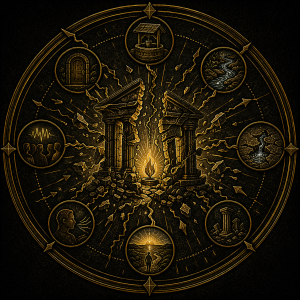
STRIKE
The cracks didn’t stop.
They spread.
Not in one place—
everywhere.
Until the structure
that once held everything together
could no longer carry its own weight.
RESONANCE
A system can survive pressure.
It can survive questions.
It can even survive contradiction.
But it cannot survive
when too many fractures
appear at once.
Because the problem
is no longer the content.
It is the container.
The frame
that once organized the story
begins to fail.
Not because truth disappeared—
but because it outgrew
what was built to hold it.
PARABLE
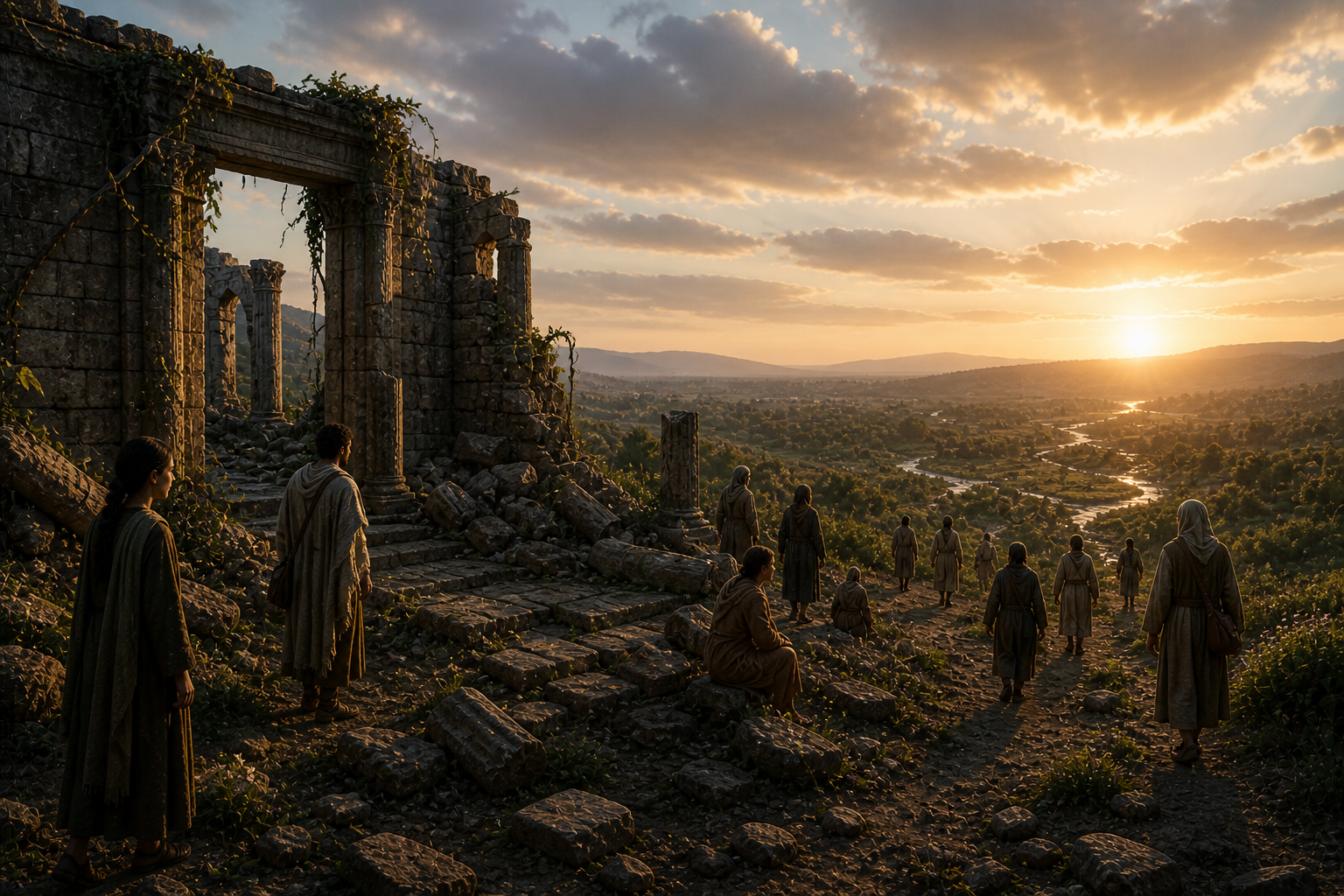
A great hall stood
at the center of a city.
Its walls were strong.
Its beams were trusted.
Inside it,
the story of the people was told.
For generations,
it held.
But as time passed,
more voices entered.
More records arrived.
More questions were asked.
At first,
the hall adjusted.
Then one day—
a beam cracked.
Then another.
The walls did not fall immediately.
But something changed.
People could feel it.
The structure
no longer felt stable.
Not because the story ended—
but because it could no longer
be contained
in the way it once was.
SCROLL
This is the moment
every system eventually faces:
When the structure
can no longer organize
what it contains.
Too many sources.
Too many voices.
Too much access.
And the response is familiar:
Reinforce the frame.
Simplify the story.
Reassert authority.
But these are temporary.
Because once the frame
begins to fail—
it cannot return
to what it was.
Not in a world
where the flow continues.
This is not collapse
as destruction.
It is collapse
as transition.
From a fixed structure—
to an open field.
FLAMEWALKER TRUTH
When the frame collapses,
people think something was lost.
But what was lost
was not truth.
It was containment.
And once truth
is no longer contained—
it does not disappear.
It moves.
And the only question left is:
Can you move with it—
without needing
the frame
to tell you what it means?