
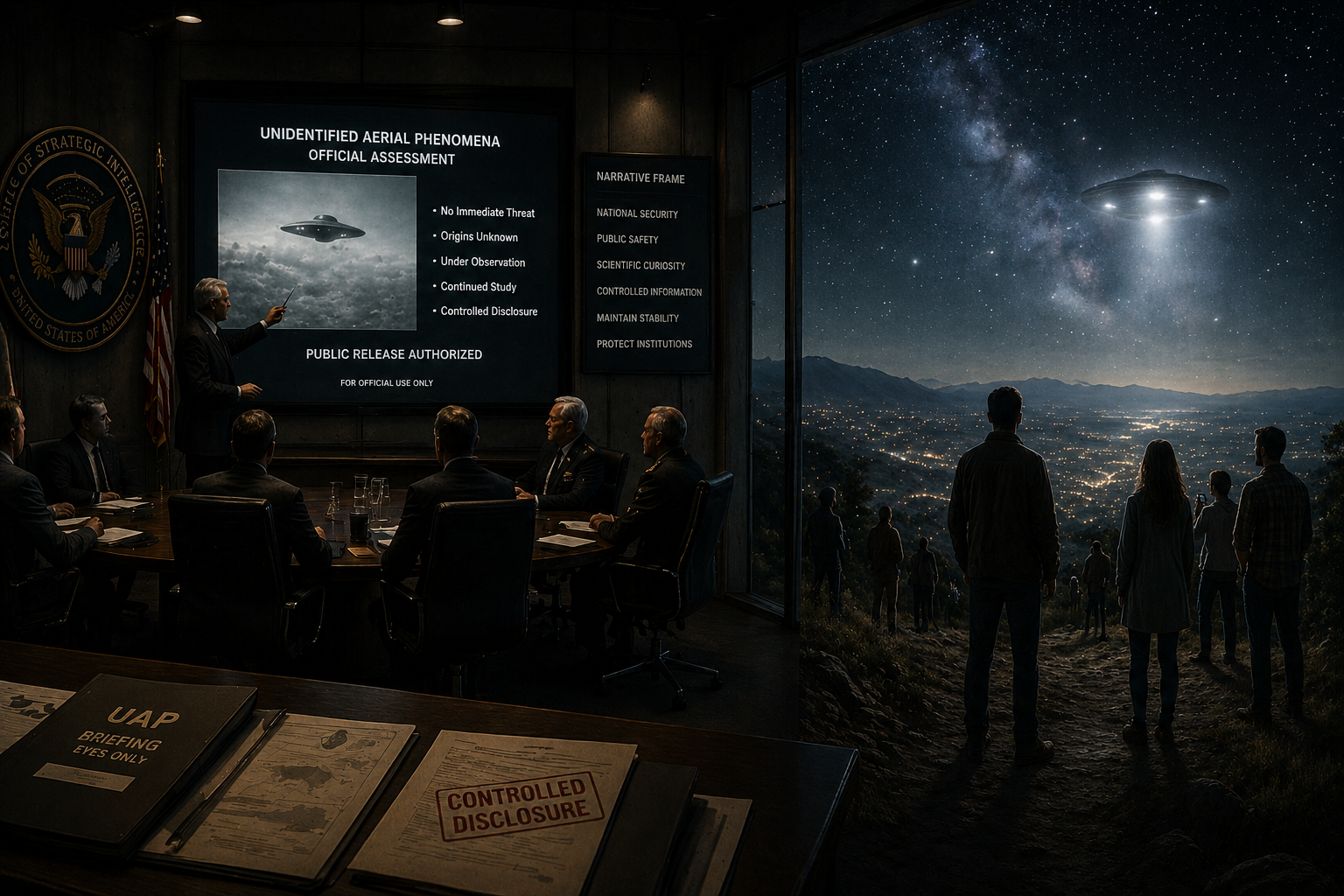
STRIKE
When power releases a secret,
it rarely releases the whole truth.
It releases the version
that keeps the structure standing.
RESONANCE
History shows a pattern.
When institutions hold information for decades,
disclosure is rarely a pure confession.
It is a framed story—
a controlled narrative
that explains the unknown
in a way that protects existing authority.
Governments manage information
not only to protect technology
and intelligence methods,
but to manage perception.
If something extraordinary exists,
the first instinct is not chaos—
it is containment
through explanation.
PARABLE
There was once a kingdom
where the sky occasionally lit
with strange lights.
The rulers told the people:
“Do not worry.
We are studying the lights.
Only our scholars can understand them.”
Years passed.
Then one day,
the council announced a revelation:
“Yes, the lights are real.”
The people gasped.
“But do not fear,” the council said.
“We will handle them.
Only the kingdom can protect you.”
Most people felt relief.
The mystery had been placed
safely back inside
the walls of authority.
But a few villagers noticed something:
The lights in the sky
had never asked permission
from the kingdom
in the first place.
SCROLL
When institutions reveal the unknown,
they rarely release it raw.
They translate it
into the language of systems:
Threat assessments.
Defense budgets.
Controlled briefings.
Official explanations.
Because systems are designed
to preserve stability.
But truth is not always stable.
Sometimes the deeper shift
is not in what is revealed—
but in what people begin to remember:
That curiosity does not require permission.
That awareness cannot be centralized.
That the universe is larger
than any institution
built to explain it.
FLAMEWALKER TRUTH
When power reveals a mystery,
listen to the words—
but also watch the frame
around the words.
Truth does not fear investigation.