
STRIKE
Exile did not end the line.
It redirected it.
RESONANCE
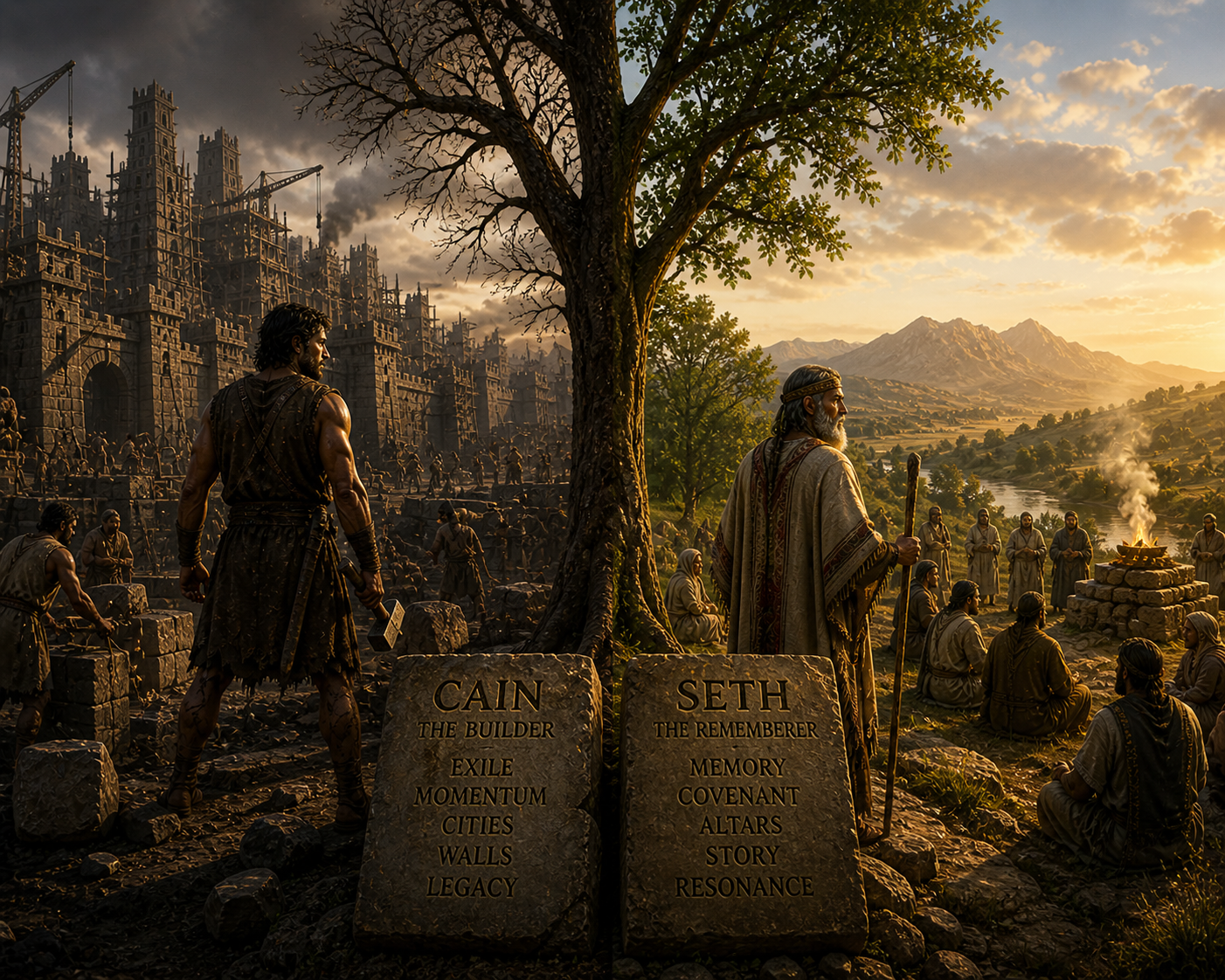
Two inheritances emerged from the same beginning.
One carried memory.
The other carried momentum.
One moved in remembrance of origin.
The other moved to recreate what was lost—
without access to what it was.
Neither line disappeared.
They developed.
PARABLE
In the shadow of the first exile,
Cain did not vanish.
He built.
The ground resisted him,
but he struck it anyway.
And from that resistance,
a city rose.
He named it—
not in repentance,
but in permanence.
The echo of his brother remained in the dust,
but the walls rose higher than the memory.
In the land of wandering,
he created structure.
Not because the wandering ended—
but because it was covered.
Elsewhere, another line continued.
Less visible.
Less defined by structure.
They carried something different—
not buildings,
but memory.
They marked time differently.
Not by expansion,
but by alignment.
One line raised walls to stabilize what was unstable.
The other held to what did not need stabilizing.
And both remained—
developing in parallel.
SCROLL
Exile is not only separation from place.
It is separation from continuity.
When continuity breaks,
response emerges.
One response preserves what remains.
Another attempts to replace what is missing.
Replacement often takes form—
structure, system, expansion.
It seeks to recreate stability externally
when it is no longer accessible internally.
Preservation moves differently.
It does not construct to compensate.
It holds to what still connects.
Over time,
these two movements shape entire trajectories.
Not as opposing forces—
but as different adaptations to the same fracture.
The question is not which line existed.
Both did.
The question is:
what was carried forward—
structure,
or continuity.
FLAMEWALKER TRUTH
Exile builds.
Memory remains.
And what is built without memory
will always seek
what it replaced.