STRIKE
What is happening now
is not new.
That is the strike.
Because the most dangerous patterns
are not the ones that arrive as strangers.
They are the ones that keep returning
in new clothes
with old intentions.
A different century.
A different border.
A different ruler.
A different speech.
But the same mechanism:
Take something sacred.
Lift it above questioning.
Attach it to force.
And call the force righteous.
That is how people are moved
without needing to be convinced.
Not by truth—
but by sanctified momentum.
And once that momentum starts,
history fills with people
who thought they were defending heaven
while serving power.
RESONANCE
This is why certain headlines
do not feel isolated.
Because this pattern does not live only in history.
It shows up in smaller places too.
In families—
where control borrows the language of love.
In churches—
where fear borrows the language of holiness.
In institutions—
where obedience borrows the language of duty.
And in every case,
the pattern survives the same way:
People are taught to trust the framing
more than their own discernment.
So when God’s name
hovers over war again—
it is not just one moment.
It is an echo.
The same machinery.
The same habit.
The same placement of something sacred
between the people
and the question they should be asking:
Who benefits?
Who bleeds?
Who is being told this is holy
before they are allowed to call it harm?
That is the resonance.
Not that history repeats exactly—
but that it repeats structurally.
PARABLE
There was once a village
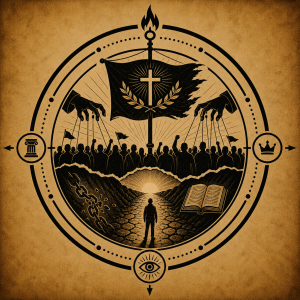
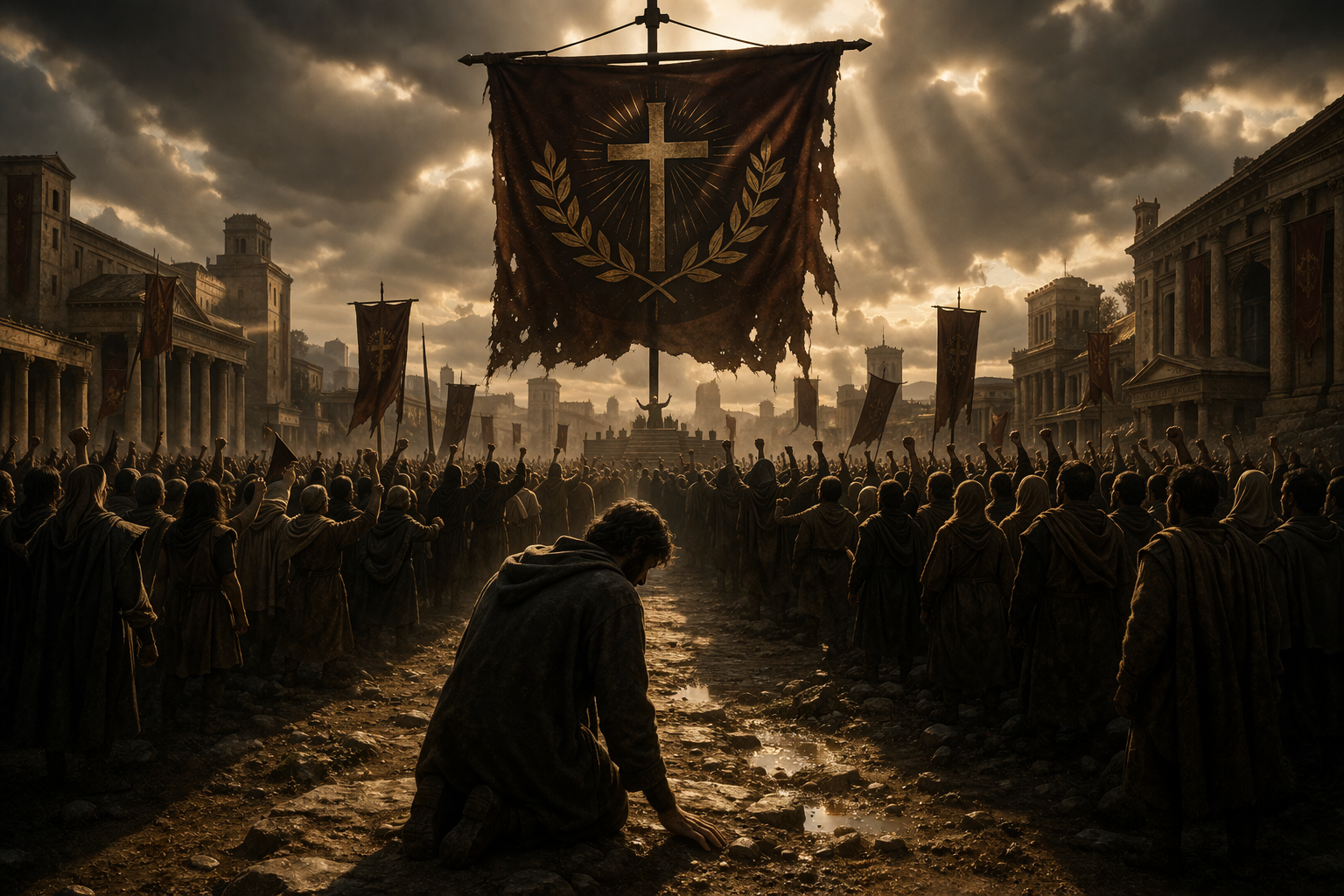
with a great banner pole at its center.
Whenever the rulers wanted the people to move,
they raised a new banner.
One year it was survival.
Another year it was honor.
Another year it was destiny.
And when the people grew tired—
or began to question—
the rulers raised the holiest banner of all.
The one stitched with sacred words.
And as soon as it rose,
the people stopped asking harder questions.
They no longer asked
where they were being led.
They no longer asked
who would pay the cost.
They no longer asked
whether the path ahead
was true—
or merely wrapped in truth’s clothing.
One day, an old pathkeeper
who had watched many banners rise
stood beneath the pole and said:
“The banner changes.
The road does not.”
Some laughed.
Some ignored him.
But a few looked down.
And when they looked down,
they saw the road beneath their feet
was stained from every age before them.
And that was when they understood:
The banner was never the proof.
It was the distraction.
SCROLL
The problem is not only
that sacred language has been used to justify harm.
The problem is that each generation
believes its version must be different
because it arrives with new names.
But the structure remains.
Power still borrows reverence.
Violence still borrows moral language.
Authority still borrows heaven
to avoid being examined on earth.
And that is why remembering matters.
Not to stay trapped in old wounds.
Not to perform outrage over history.
But to recognize the mechanism
before it claims another age.
Because once you see the pattern,
you cannot unsee it.
You begin to notice
how often the sacred is lifted—
not to awaken conscience,
but to bypass it.
You begin to notice
that the holiest words
are often brought in
when something unjust
is asking not to be questioned.
So this is not only about the past.
And it is not only about now.
It is about whether we are willing
to look at the repeating banner
and say:
I have seen this before.
I know what it does.
And I will not mistake borrowed holiness
for truth again.
That is how the spell weakens.
Not when the banner falls by itself—
but when the people beneath it
stop surrendering their sight.
FLAMEWALKER TRUTH
Sacred language does not make something true.
It makes it harder to question.
And when questioning is removed,
discernment is replaced with obedience.
So the work is not to reject what is sacred—
but to refuse to let it be used
as a shield for what is not.
Because truth does not need protection
from being examined.
Only power does.
And the moment you can see
where the sacred is being used
to silence the question—
is the moment
you begin to see clearly again.