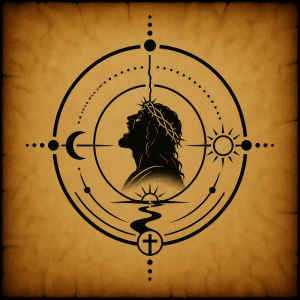

STRIKE
We hear it as breaking.
A voice at the edge.
A final unraveling.
A cry that sounds like defeat.
“My God, my God…
why have you forsaken me?”
And in that moment—
we think everything fell apart.
RESONANCE
That line has been carried a certain way.
As abandonment.
As separation.
As the point where even heaven went silent.
But the text does not isolate it.
That sentence
is not the whole thought.
It is the opening line
of something already written.
From Psalm 22:1.
And Psalm 22
does not end in forsaking.
It moves.
From anguish—
to remembrance.
From pain—
to proclamation.
The same voice that cries out
also declares:
“He has done it.”
But we don’t carry that part.
We keep the first line.
We drop the rest.
And in doing so—
we change the meaning.
PARABLE
A messenger arrived at a gathering
and spoke a single line aloud.
The crowd froze.
They heard sorrow.
They heard loss.
They heard something ending.
And they whispered:
“It’s over.”
But an elder in the back stood slowly
and said:
“You’ve only heard the first sentence.”
The room went quiet.
“Do you not recognize where that comes from?”
But they did not answer.
Because they had learned
to hear fragments
as if they were complete.
So the elder began to recite the rest.
Line by line.
Word by word.
And as the passage unfolded—
the tone shifted.
What began in anguish
ended in completion.
What sounded like abandonment
revealed itself as fulfillment.
The crowd looked at one another—
not because the words had changed—
but because they had never listened long enough
to hear the whole.
SCROLL
The crucifixion account records a cry
that has been widely interpreted
as the moment of divine separation.
“My God, my God, why have you forsaken me?”
But this is not an isolated statement.
It is a direct reference
to Psalm 22—
a passage known to those who heard it.
A passage that begins in distress
but moves toward trust, remembrance,
and ultimately, completion.
By isolating the opening line,
the meaning is narrowed.
The fullness of the reference is lost.
And the cry is reframed
as something it was not meant to stand alone as.
This is not a matter of added detail
or missing information.
It is a matter of context removed.
A fragment lifted from its source
and reinterpreted without its conclusion.
When read as part of the whole,
the cry is not the end of the story.
It is the beginning of a passage
that leads beyond it.The deepest distortions
are not always found in what is false.
They are found
in what is incomplete.
A single line,
removed from its source,
can reshape an entire moment.
Not because the words changed—
but because the context did.
So the work is not just to read what was said.
It is to return
to where it came from.
Because truth is not carried in fragments.
It is carried in fullness.
And when you hear a line
that feels final—
ask yourself:
Is this the end of the thought…
or the beginning of something
you were never taught to finish