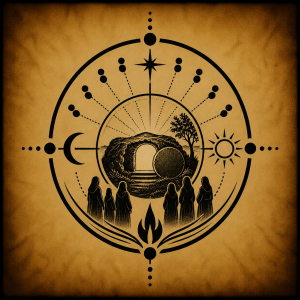
STRIKE
No one saw him rise.
Not one voice records the moment.
Not one witness describes the breath returning.
And even the ones who came first—
were not as alone as we remember.
RESONANCE
We’ve been given a clean image.
One woman.
One moment.
One discovery.
Mary at the tomb.
But the text doesn’t stay that narrow.
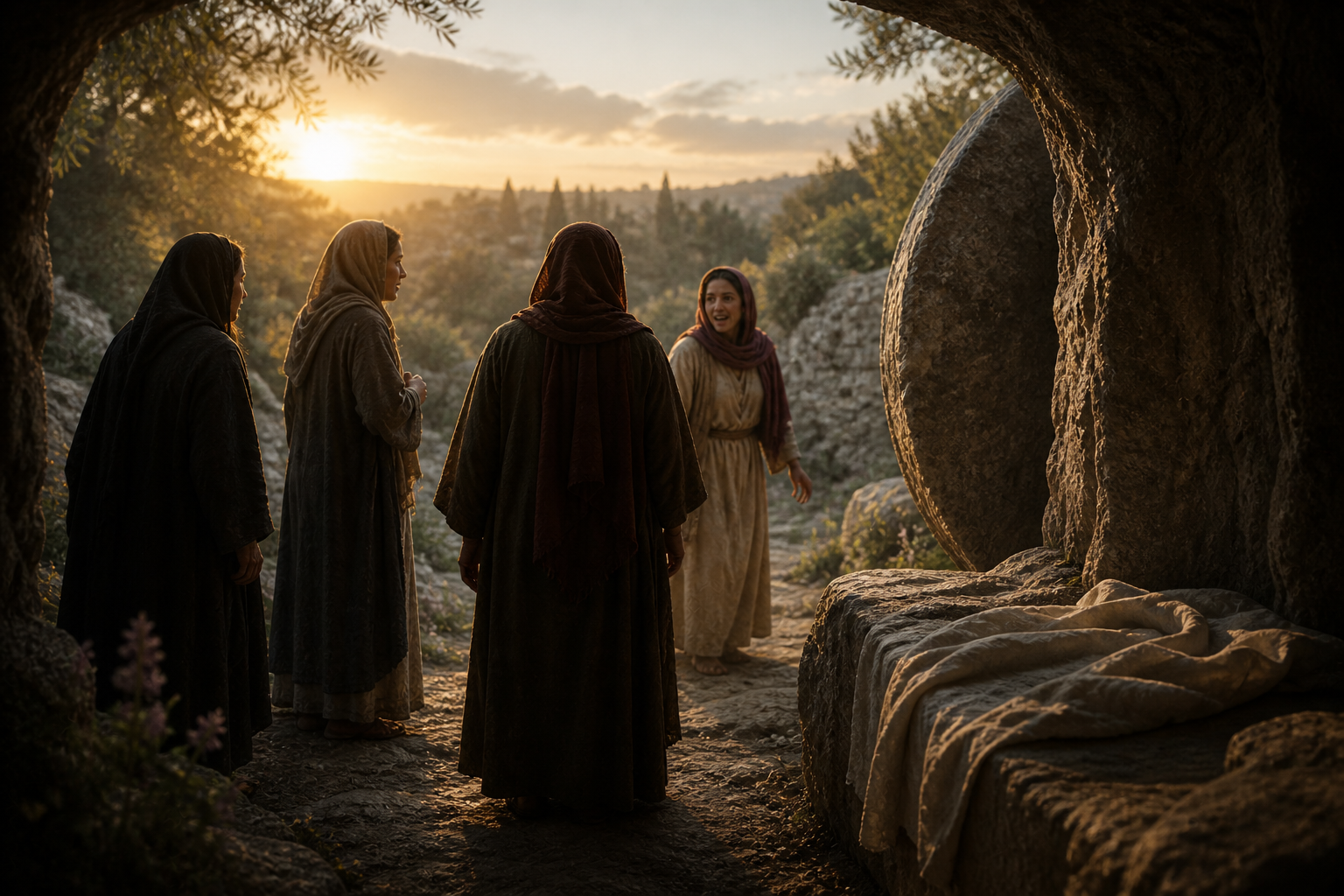
In Luke 24:10, it names several:
Mary Magdalene,
Joanna,
Mary the mother of James,
and others.
In Mark 16:1—again, more than one.
In Matthew 28:1—still more than one.
But in John 20:1, the focus narrows.
Mary.
One figure.
One voice.
And that’s the version that stays in memory.
Not because it’s the only one written—
but because it’s the easiest one to carry.
So the moment compresses.
From many witnesses—
to one image.
From a shared arrival—
to a solitary figure in the doorway.
And in that compression,
we begin to think we’ve seen the whole scene.
PARABLE
A group once stood at the edge of an empty place.
They arrived together—
feet on the same path,
breath in the same morning air.
They saw the same thing:
The stone moved.
The space opened.
The absence where presence had been.
But when they returned to tell it,
the story changed shape.
One voice rose above the others.
Not because the others weren’t there—
but because one voice was remembered.
So over time,
the many became one.
And the one became the image.
And the image became the story
people told as if it had always been that way.
Until someone came back to the place
and asked:
“Who was here?”
And the ground answered:
“More than you were told.”
SCROLL
The resurrection accounts do not describe the moment of rising.
They describe the discovery.
An empty tomb.
A moved stone.
A missing body.
A presence encountered after.
And those who came first were not singular.
Multiple accounts record multiple women.
Yet the retelling often narrows the moment
into one figure—
Mary Magdalene—standing alone.
This is not a contradiction.
It is a shift in focus.
A moment witnessed by many
told through one lens.
But when that lens becomes the only image remembered,
the fullness of the scene is reduced.
And something subtle is lost:
That the first encounter with the empty tomb
was not isolated.
It was shared.
And even more—
The central moment itself remains undescribed.
No one saw the exact instant.
No one recorded the mechanics.
Only the outcome is given.
Which means the text does not ask us
to visualize the rising.
It asks us to respond
to the reality that it had already happened.
FLAMEWALKER TRUTH
Not every distortion is something added.
Some are something narrowed.
A moment witnessed by many
becomes remembered as one.
A silence left in the text
becomes filled with imagined detail.
And over time,
what was layered or compressed
feels more real
than what was actually written.
But the page still holds its ground.
It tells you what was seen.
It tells you who was there.
And it leaves space
where it chose not to speak.
So return to it.
Because truth is not always louder
when it is complete.
Sometimes it is quieter—
wider—
and shared by more voices
than we were taught to remember.