
The Corrected Silence
Lived Experience:
Not only tradition fills the silence.
Correction can do it too.
And that is where the pattern becomes harder to see—
because once something sounds more accurate,
we stop asking
whether we are still reading the text
or already building on top of it again.
Resonance
This is the deeper turn in the spiral.
At first, the work feels simple:
Remove what was added.
Correct what was mistranslated.
Return to what was actually written.
And that work matters.
It matters when names are distorted.
It matters when assumptions become doctrine.
It matters when tradition hardens itself
against the text that should have kept it honest.
So when someone points to Junia and says,
“Wait—this was not a man after all,”
that matters.
When someone says,
“The reading has been narrowed,
and the tradition built around it
may not be as secure as people thought,”
that matters.
That is not rebellion.
That is return.
But then comes the second move.
And the second move
is where the old pattern
puts on new clothes.
Because now the mind says:
If this was corrected,
then it must resolve the larger question.
If this line is reopened,
then it must settle the structure.
If this reading is more accurate,
then it must tell us
what the institution should become.
And just like that,
we leave the text again.
Not by defending the old additions—
but by building new conclusions
past the edge of what was actually said.
That is why this matters so much.
Because tradition can fill the silence
with restriction.
And correction can fill the silence
with expansion.
Different motives.
Different direction.
Same human reflex.
We do not like open space.
We want the line
to finish the argument for us.
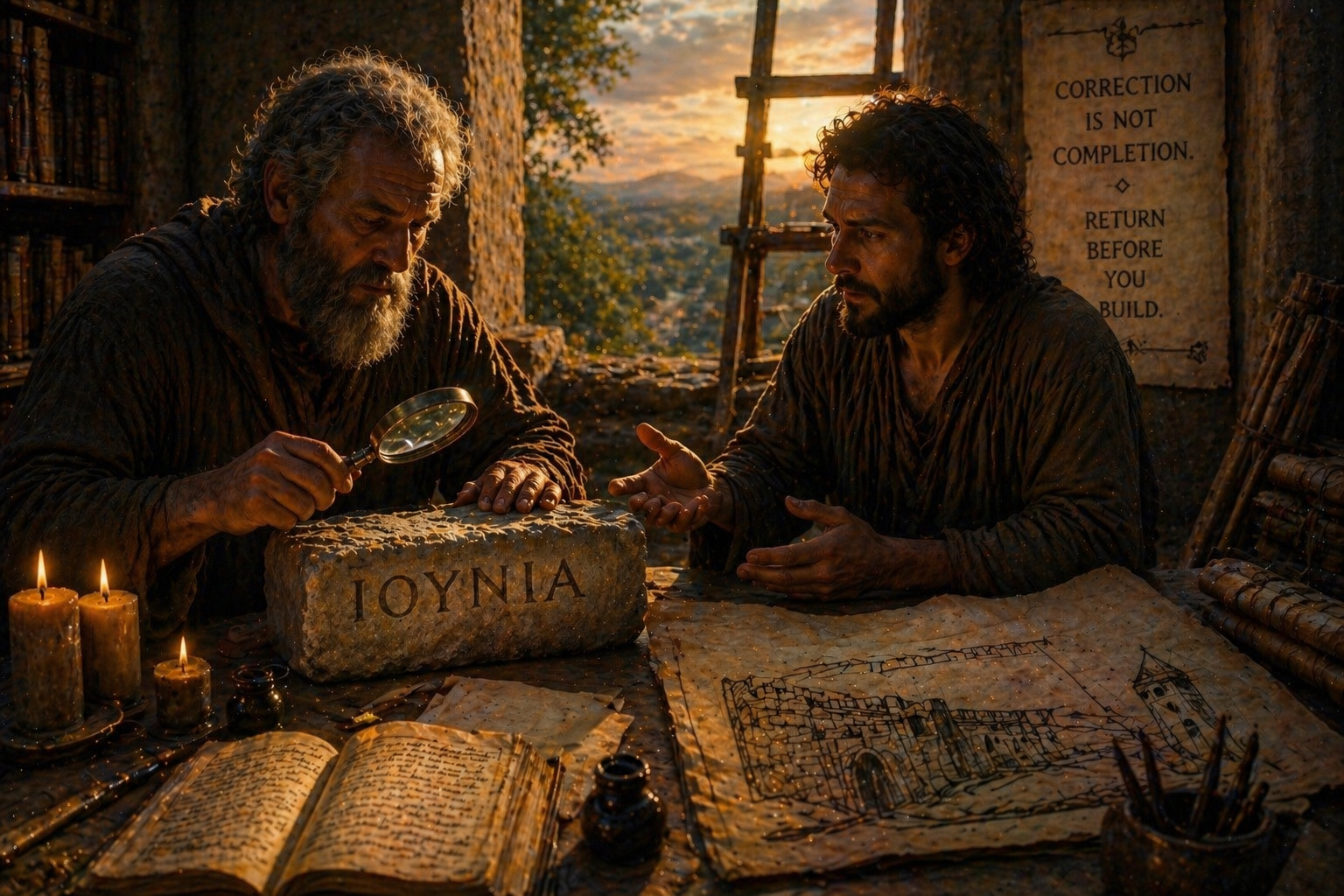
Parable:
THE STONE AND THE WALL
A scholar and a builder
stood before an old stone wall.
For years, everyone had said
one stone in the center
was plain and ordinary.
But the scholar cleaned it,
studied it,
turned it in the light, and said:
“No.
This stone was misnamed.
It is not what they said it was.”
The builder nodded.
At first, both were relieved.
Because a wrong thing
had finally been called wrong.
A covered thing
had finally been uncovered.
But then the builder stepped back,
looked at the whole wall, and said:
“If that stone was misnamed,
then we should tear down this side,
raise a tower there,
open a gate here,
and rebuild the whole structure at once.”
The scholar turned and asked:
“Does the stone say all that?”
The builder answered:
“No.
But it suggests it.
It points toward it.
It opens the door.”
The scholar stood in silence.
Then said:
“Perhaps.
But first let the stone
be what it is
before you make it carry
what you want next.”
The builder grew restless.
Because he did not want
a corrected stone.
He wanted
a corrected world.
But the scholar kept his hand
on the one stone
and said quietly:
“There is a difference
between uncovering what was true
and forcing truth
to finish our designs.”
And the wall remained standing—
not because nothing mattered,
but because one revealed thing
did not yet give permission
to imagine the rest as settled.
Scroll:
This is the discipline of reading:
To recognize that correction
does not automatically authorize completion.
A corrected name matters.
A recovered translation matters.
A reopened line matters.
But once a text is corrected,
the temptation intensifies.
Because accuracy carries authority—
and authority invites expansion.
So what begins as return
can become construction.
What begins as restraint
can become agenda.
What begins as careful reading
can become the next overlay.
This does not mean the questions are invalid.
It does not mean institutions should never be examined.
It does not mean weak structures should be protected.
It means something narrower—
and therefore harder:
The text must be allowed
to say exactly what it says
without being conscripted
into saying more
simply because we need more from it.
In the matter of Junia,
the correction exposes a fissure.
It reveals that tradition
may have suppressed, narrowed, or misheard
something important.
That alone is significant.
But once that significance is seen,
the next question must be handled carefully.
Not:
“What can I make this solve?”
But:
“What does this actually give me?
And where does it stop?”
Because that stopping place
is where honesty lives.
The text may open a door.
It may trouble an assumption.
It may destabilize a structure.
But it does not automatically speak
every conclusion people want to build
on the ground it just reopened.
That is the trap.
Tradition says too much.
Correction clears the room.
Then correction itself
begins arranging furniture.
And before long—
the silence is full again.
So the real work is not merely
to oppose bad readings.
It is to develop enough discipline
to stop
before your own certainty
becomes the next layer
someone else must later remove.
FLAMEWALKER TRUTH
Not every challenge to tradition
is pure return.
Sometimes it is return first—
and construction second.
That is why the work must stay honest.
Because the text is not here
to carry all our unfinished arguments
to the conclusion we prefer.
It is here
to say what it says,
to leave open what it leaves open,
and to confront us
with the places
where we must choose:
to listen—
or to keep building.
So yes—question the tradition.
Yes—correct the mistranslation.
Yes—reopen the line.
But then stop long enough
to ask the harder question:
Am I still returning to the text?
Or have I already begun
to fill the silence again?

The Space
Not a storefront.
Not a schedule.
Just something you return to
when it calls you back.
Links
© Rabbit’s Warren “All things made with intention”
“No gatekeepers. Just paths.”